Interactive family portrait. Use Tab to move between people, then press Enter or Space to open a thought. Press Escape to close an open thought.
About Me
The subject of the archive
A portrait assembled from evidence
A normal biography can tell you what I claim to be. LifeLoggerz gives me a more interesting option: show the family I come from, the things I repeatedly do, the culture I return to, and eventually what years of data and writing suggest about me.
Several answers to the same question
Who am I?
No single paragraph gets to own the answer. Each part of the archive sees the person from a different angle.
Where I come from
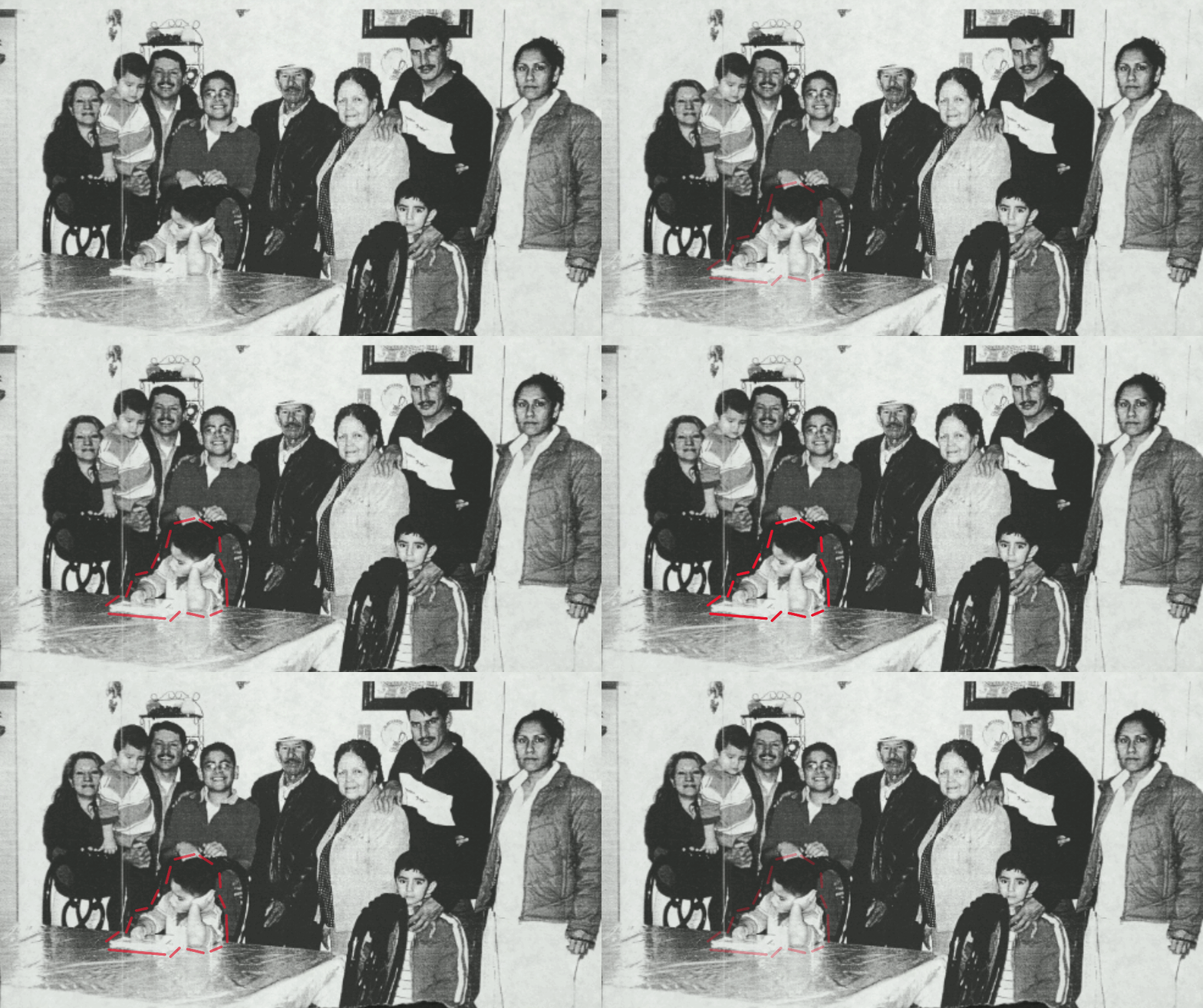
Family Roots traces both sides of my family from México into the specific communities my parents and grandparents knew, then connects the geography to photographs and family stories.
Open Family Roots above →The Quantified Me
Instead of saying I read, practice guitar, study languages, or move through phases, the archive can show the evidence: totals, calendars, records, and long-term patterns.
Explore the data →The Written Me
A public-safe diary corpus will eventually offer the qualitative counterpart: recurring themes, concerns, joys, phrases, values, and changes that statistics alone cannot describe.
The José constellation
José José, José María Napoleón, Joseph, Yusuf, José Martí, José Rizal, and other namesakes orbit a central signature—part cultural collage, part playful identity map.
Enter the constellation →What I do
Guitar, dance, running, languages, research, building things, reading, and the pursuits that recur through different periods of my life.
Explore my pursuits →Things I love
Books I keep thinking about, music that moves me, paintings I stop for, people who shaped my thinking, words I love, and places that matter to me.
See what stayed with me →Habits, rhythms & deliberate boundaries
How I live
This is less a rigid routine than a personal operating system: a handful of daily anchors, recurring weekly rhythms, rules that keep the whole thing sustainable, and a few things I have deliberately chosen not to make part of my life.
Daily anchors
The small threads I try not to let break.
I keep a detailed chronological record of the day—not only highlights, but the ordinary sequence that would otherwise disappear.
Bible reading is a daily anchor: slow, chapter by chapter, with questions and reflections preserved along the way.
Even on crowded days, I try to put my hands on the instrument. A small session keeps the thread from breaking.
Language study and a daily dictionary habit keep vocabulary, curiosity, and long-term learning in motion.
The numbers behind LifeLoggerz are maintained as life happens: pursuits, time, reading, movement, and other records I care about.
Recurring rhythms
Not necessarily daily, but unmistakably part of the life.
PhD work gives the week its largest block of structure: lab work, analysis, reading, writing, meetings, and problem-solving.
Classes and practice bring movement, music, social time, and a very different kind of learning into the week.
Walking, the treadmill desk, running when it is in season, and other exercise keep long desk-heavy days from becoming entirely sedentary.
Reading often rides alongside chores, walks, drives, repetitive work, and other parts of life that can carry a second layer of attention.
LifeLoggerz and other personal projects give me somewhere to turn curiosity into something concrete instead of leaving every idea as a note.
Rules of the system
A short session counts. Continuity is often more valuable than waiting for the perfect uninterrupted hour.
Not every pursuit can be maximal at once. Some move to the foreground for a season while others stay on maintenance.
Templates, shortcuts, automation, and reusable workflows are worth the upfront effort when they reduce friction for years.
The tracking is meant to preserve and illuminate the life—not become the life. The system should serve the experience.
What I don’t do
Absence shapes a life too.
I do not use them. It is a simple personal boundary rather than a recurring decision.
I do not rely on caffeine as part of my normal routine.
I have largely kept social media out of daily life and protect that attention for people, projects, reading, and practice.
A rhythm, not a timetable
What a day tends to contain
The order changes with classes, lab work, family, errands, and whatever project has caught fire. The ingredients recur more reliably than the clock times do.
- 1 Record Log the day as it unfolds.
- 2 Work Research, study, write, solve.
- 3 Move Walk, train, run, or dance.
- 4 Practice Keep skills and streaks alive.
- 5 Build & read Projects, books, and ideas.
- 6 Close the loop Finish the record; preserve the day.
How I live is not the same as what I track. This section describes the behavior. LifeLoggerz records the evidence left behind by it.
Principles, beliefs & recurring convictions
A little of how I see the world
Habits describe what I do. These get closer to why. This is not a creed, a claim to perfect consistency, or advice for everyone else. It is a working map of the ideas I keep returning to as I try to decide what deserves my time, attention, ambition, gratitude, and care.
Foundations
The convictions underneath the habits—the things that shape how I interpret achievement, time, other people, and my place in the world.
-
Faith comes before self-importance
I believe the abilities, opportunities, people, and good fortune in my life are gifts from God, not evidence that I am somehow above other people. Achievement should deepen gratitude, not inflate the ego.
-
Remember how small you are
There is freedom in remembering that I am one person in an enormous world and a brief stretch of history. My work can matter without requiring me to imagine that I am the center of anything.
-
Be grateful for the ordinary fact of being alive
Health, family, another morning, useful work, music, movement, a conversation, a meal—none of these are owed to me. I want gratitude to remain available before life has to take something away to teach it.
-
Time is finite; that makes it precious, not merely scarce
Mortality gives urgency to life, but I do not want that urgency to become a demand that every minute be optimized. A day can be worthwhile because it was lived well, not because every hour produced something measurable.
-
Family and roots are part of the self
I did not appear from nowhere. Family, place, language, sacrifice, migration, memory, and the lives before mine are part of the explanation for who I am. Remembering them is a form of gratitude.
Character & practice
These are less about what I believe in the abstract and more about the kind of person I am trying—imperfectly—to become.
-
Practice self-mastery, not self-denial
Anger, sadness, desire, affection, pride, fear, and excitement are human signals, not commands. I want to acknowledge them honestly without automatically letting them govern what I do.
-
Ambition is good when it remains a servant
I like striving, building, learning, competing, and seeing how far I can go. But accomplishment is a poor master. The point of ambition should be to enlarge a life and increase what I can contribute—not to make rest, relationships, or ordinary happiness feel illegitimate.
-
Consistency beats perfection
A small practice kept alive is usually worth more than an ideal routine repeatedly abandoned. Simplify when necessary; do not confuse imperfect progress with failure.
-
Stay willing to be a beginner
Curiosity requires periods of clumsiness. I want to keep entering rooms where I do not yet know what I am doing and resist the temptation to protect competence by avoiding new things.
-
Make more than you merely consume
Ideas become more valuable to me when they leave the notebook and become a page, tool, experiment, song, analysis, system, or other concrete thing. Creation is one of the ways I understand the world.
-
Show the evidence—and admit uncertainty
I prefer traceable records to flattering adjectives. Definitions, missing data, estimates, doubts, and changing conclusions belong beside the result. Being precise about what I do not know is part of being truthful about what I do know.
-
Measure to understand, not to rank existence
Numbers can reveal patterns memory misses, which is why I love tracking. But a human life is not a scoreboard. Measurement should create perspective and better questions, not reduce meaning to whatever happens to fit in a cell.
Living fully
The corrective to turning life into one endless improvement project: some things are valuable precisely because they are human, inefficient, uncertain, or enjoyed for their own sake.
-
Systems should serve the life
Tracking, templates, shortcuts, and automation are useful when they return attention to living. The system is infrastructure—not the destination. If maintaining the machinery consumes the thing it was built to support, the machinery needs to change.
-
Optimize in service of living
Efficiency matters, but diminishing returns are real. I want to save time so it can be spent on people, practice, movement, reading, creating, wandering, conversation, and the parts of life that resist optimization.
-
People are not optimization problems
Friendship, family, affection, and love involve uncertainty, compromise, vulnerability, and time that cannot be justified by maximum efficiency. Choosing particular people means accepting that life is lived through commitments, not through endlessly comparing every possible alternative.
-
Enjoyment does not need to earn its keep
Music, dancing, a book, a joke, a walk, a beautiful object, a good meal, or an afternoon spent making something can be worthwhile without becoming productive. Pleasure and play are not defects in an otherwise serious life.
-
Preserve the ordinary
Milestones are easy to remember; ordinary Tuesdays disappear. The mundane texture of a life is worth recording because, given enough time, it becomes history too—and because the ordinary days are where most of life actually happens.
-
Try to be able to say: today I lived
A good day does not require greatness. I want enough work to respect my abilities, enough discipline to respect my goals, enough gratitude to notice what I have, and enough life left unoptimized that the day feels inhabited rather than merely completed.
Abilities, appetite & unfinished curiosity
What I can do, want more of, and still want to learn
A life is more than completed achievements. This is a moving map of the skills already built, experiences I would like to make more room for, and the odd or ambitious things I hope to learn someday.
built already Do more
make room Learn
curiosity queue
Already part of my life
Things I do / can do
Skills and disciplines with real history behind them. Where the archive supports it, these can grow into evidence-backed totals instead of résumé adjectives.
Known, but underused
Things I want more of
Not every aspiration requires mastery. Some things simply deserve a larger share of life than they currently get.
The curiosity queue
Things I want to learn
Some are serious ambitions; others are gloriously specific curiosities. Either way, they reveal where my attention wants to wander next.
Designed to become data-backed. The second tag on each card is the metric slot: actual hours, sessions, years active, frequency, last practiced, mileage, classes, or another useful measure can replace the label as the archive gains a clean source of truth. No invented precision.
Future challenge mode: items in the learning queue can eventually become one-day, one-week, or longer experiments—pick a curiosity, define what “learned enough” means, track the effort, and preserve the result.
A name becomes a map
The José constellation
My name is hardly mine alone. Two rings show a rotating sample of people, name cousins, and cultural references connected to José; the archive below holds the larger collection.
Hover gives you a quick look. Click or tap pins a José here while you explore the rest of the constellation.
Explore all 64 Josés Search the starter archive, filter it, or put any entry into the constellation.
José José
Music · MexicoMexican singer whose stage name doubled the name itself: José José.
José María Napoleón
Music · MexicoMexican singer-songwriter known simply as Napoleón, with José María at the front of the name.
José Carreras
Music · SpainSpanish operatic tenor and one of the famous Three Tenors.
José Martí
Literature · CubaCuban writer, poet, essayist, and independence figure whose work became central to Cuban intellectual history.
José Rizal
Literature · PhilippinesFilipino writer and reformer whose novels and execution made him a national symbol in the Philippines.
José Mourinho
Sports · PortugalPortuguese football manager known for a long career at major European clubs and the nickname “The Special One.”
José Feliciano
Music · Puerto RicoPuerto Rican musician and guitarist with a career spanning Latin music, pop, and acoustic interpretations.
José Luis Perales
Music · SpainSpanish singer-songwriter whose romantic songs became widely known across the Spanish-speaking world.
José Saramago
Literature · PortugalPortuguese novelist and Nobel laureate known for distinctive, philosophical fiction.
José de San Martín
History & politics · ArgentinaMilitary leader central to the independence of Argentina, Chile, and Peru.
José Guadalupe Posada
Art & film · MexicoMexican printmaker and illustrator especially associated with satirical calaveras and popular graphic art.
José Clemente Orozco
Art & film · MexicoMexican painter and muralist, one of the major figures of Mexican muralism.
José Cuervo
Popular culture · MexicoA José that escaped biography entirely: the name became globally recognizable through the historic tequila brand.
José Alfredo Jiménez
Music · MexicoMexican singer-songwriter whose ranchera compositions became standards of Mexican popular music.
José Ortega y Gasset
Ideas & science · SpainSpanish philosopher and essayist associated with influential writing on society, culture, and mass politics.
José Andrés
Food & culture · Spain / U.S.Spanish-American chef and humanitarian who founded World Central Kitchen.
José Altuve
Sports · VenezuelaVenezuelan baseball player known for a long major-league career.
José Ferrer
Art & film · Puerto RicoPuerto Rican actor and director with a major twentieth-century stage and film career.
José Raúl Capablanca
Sports · CubaCuban chess grandmaster and world champion celebrated for exceptionally clear positional play.
José Hernández
Literature · ArgentinaArgentine writer and poet best known for the gaucho epic Martín Fierro.
José María Morelos
History & politics · MexicoPriest and military leader who became one of the central figures of Mexican independence.
José Vasconcelos
Ideas & science · MexicoMexican writer, philosopher, and education figure whose ideas shaped twentieth-century cultural debates.
José Revueltas
Literature · MexicoMexican novelist, essayist, screenwriter, and political activist.
José Pablo Moncayo
Music · MexicoMexican composer and conductor, especially remembered for the orchestral work Huapango.
José Luis Cuevas
Art & film · MexicoMexican artist associated with the Generación de la Ruptura and a highly recognizable graphic style.
José Luis Rodríguez
Music · VenezuelaVenezuelan singer and actor widely known by the nickname “El Puma.”
José Mujica
History & politics · UruguayUruguayan political figure and former president widely associated with an unusually austere public image.
José Antonio Abreu
Music · VenezuelaVenezuelan musician and educator who founded the music-education program El Sistema.
José Bautista
Sports · Dominican RepublicDominican baseball player known for his power hitting and a long major-league career.
Joseph
Name family · EnglishThe English form of the same ancient name family, showing how José extends far beyond Spanish.
Yusuf
Name family · ArabicThe Arabic form of the Joseph/José name family, connecting the constellation across languages and traditions.
Giuseppe
Name family · ItalianThe Italian form of Joseph/José, another branch of the same name traveling through language.
José Canseco
Sports · Cuba / U.S.Cuban-American baseball player remembered as one of the prominent power hitters of his era.
José Abreu
Sports · CubaCuban baseball player known for a successful career in Cuba and Major League Baseball.
José Ramírez
Sports · Dominican RepublicDominican baseball player known for combining power, speed, and infield play.
José Aldo
Sports · BrazilBrazilian mixed martial artist widely regarded among the leading featherweights of his generation.
José Lezama Lima
Literature · CubaCuban poet, novelist, and essayist associated with dense, baroque literary experimentation.
José Donoso
Literature · ChileChilean novelist and short-story writer associated with the Latin American Boom.
José Emilio Pacheco
Literature · MexicoMexican poet, essayist, novelist, and translator with a major place in modern Mexican letters.
José Agustín
Literature · MexicoMexican novelist and essayist strongly associated with the Literatura de la Onda movement.
José Gorostiza
Literature · MexicoMexican poet and diplomat best remembered for the long poem Muerte sin fin.
José Asunción Silva
Literature · ColombiaColombian poet whose work became an important part of Spanish-language modernismo.
José Eustasio Rivera
Literature · ColombiaColombian writer best known for the novel La vorágine.
José María Arguedas
Literature · PeruPeruvian novelist and anthropologist whose work explored Indigenous and mestizo life in the Andes.
José Zorrilla
Literature · SpainSpanish poet and dramatist best known for Don Juan Tenorio.
José de Espronceda
Literature · SpainSpanish Romantic poet known for dramatic, rebellious verse.
José Iturbi
Music · SpainSpanish pianist, conductor, and actor whose career crossed classical performance and Hollywood.
José White Lafitte
Music · CubaCuban-French violinist and composer remembered for virtuosic nineteenth-century concert music.
José Maurício Nunes Garcia
Music · BrazilBrazilian priest and composer whose sacred music is central to the colonial and early imperial repertory.
José Padilha
Art & film · BrazilBrazilian film director, producer, and screenwriter known for crime dramas and documentaries.
José Mojica Marins
Art & film · BrazilBrazilian filmmaker and actor famous for creating the horror character Coffin Joe.
José Luis Sert
Art & film · SpainSpanish architect and urban designer associated with modernist architecture and planning.
José Celestino Mutis
Ideas & science · Spain / ColombiaPhysician, botanist, and naturalist who led major scientific work in New Granada.
José Mariano Mociño
Ideas & science · MexicoMexican naturalist and physician involved in the Royal Botanical Expedition to New Spain.
José Bonifácio de Andrada e Silva
History & politics · BrazilBrazilian statesman and naturalist closely associated with the country’s independence era.
José Gervasio Artigas
History & politics · UruguayPolitical and military leader remembered as a foundational figure in Uruguayan history.
José Joaquín de Olmedo
Literature · EcuadorEcuadorian poet and political figure active during the Spanish American independence period.
José P. Laurel
History & politics · PhilippinesFilipino jurist and political figure prominent in twentieth-century Philippine history.
José Abad Santos
History & politics · PhilippinesFilipino jurist remembered for public service and his death during the Second World War.
José Burgos
History & politics · PhilippinesFilipino Catholic priest and reform figure remembered as one of the Gomburza martyrs.
José Palma
Literature · PhilippinesFilipino poet and soldier whose Spanish poem Filipinas supplied the lyrics later associated with the national anthem.
José Maceda
Music · PhilippinesFilipino composer and ethnomusicologist known for experimental music and research into Asian musical traditions.
José García Villa
Literature · PhilippinesFilipino poet and writer known for formally inventive English-language poetry.
José María Heredia
Literature · CubaCuban poet often associated with early Romanticism in Spanish America.
No Josés match those filters yet.
Sixty-four is only a seed. The constellation can stay selective even if the archive eventually grows into hundreds or thousands of names.
The archive as a mirror
What the record can say that a résumé cannot
The most LifeLoggerz version of an About page is not a list of adjectives. It is a set of doors into the evidence behind them.
Culture as autobiography
Pieces I carry with me
Not a ranked top ten. These are the scenes, lines, sounds, images, and odd details that stayed in my head. The full Culture pages can hold the larger archive; About Me only needs a few revealing fragments.
Sancho governing Barataria
A tiny, absurd dispute involving a tailor is one of those comic scenes that survives in memory long after most plot details fade. Small moments can become the part of a book I carry longest.
Don Quixote“Maintenant, je serais frénétique et fulminant !”
A sentence remembered for its theatrical force as much as its meaning: language turning into motion, bravado, rhythm, and personality.
Cyrano de BergeracMilo’s impossible commercial web
The escalating explanation of where Milo flies for produce and how his syndicate works is the kind of absurd machinery that becomes its own memory of the book.
Catch-22