A Simple Shorthand System — Before You Commit to Something Harder
✍️ A Simple Shorthand System — Before You Commit to Something Harder
Back in 2021, I looked into traditional shorthand systems like Gregg and Pitman.
They fascinated me — fast, elegant, and used by reporters and court clerks for over a century.
But the idea of learning a new writing system (new alphabet, new symbols, months of training) was… intimidating.
So, I went the LifeLoggerz route: build a system that’s just enough.
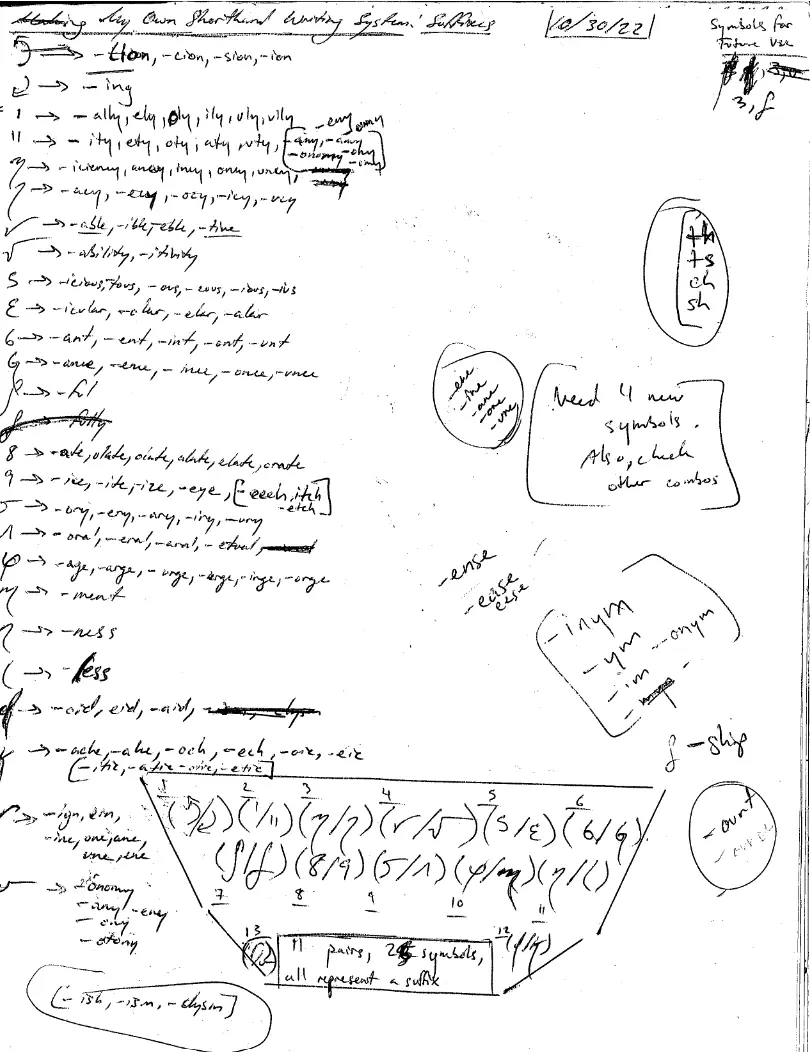
I began developing my own suffix-based shorthand, designed to make writing faster without requiring full retraining.
It’s not about perfection — it’s about speed and efficiency in everyday writing, especially for note-heavy STEM work.
🔡 The Core Idea
Instead of creating a new alphabet, I focused on the most common suffixes and word endings — things like:
-tion,-sion,-ion-ing-ity,-ety-ness-less-ment-able,-ible-ance,-ence
Each one gets its own symbol — a small curl, slash, or curve that you can append naturally at the end of a root word.
The result? A smooth flow that feels like normal writing, just stripped down.

✂️ Suffix Examples
Here are a few from my handwritten system:
| Suffix | Shorthand Symbol | Example |
|---|---|---|
| -tion / -sion / -ion | → (curve mark) | education → educ→ |
| -ing | ⤴ | running → run⤴ |
| -ity / -ety | ɪ | velocity → velocɪ |
| -ness | ʃ | kindness → kindʃ |
| -able / -ible | ∆ | readable → read∆ |
| -ment | ɯ | development → developɯ |
The exact symbols are personal — what matters is the consistency.
Once your brain internalizes them, you’ll find yourself writing at a steady sprint.
🧠 Abbreviations for Common Words
After the suffixes, I made a second page with abbreviations for frequent words and phrases.
This is where the real speed boost happens.

A few examples from my list:
| Word / Phrase | Abbreviation | Notes |
|---|---|---|
th / ch / sh | θ / ç / ʃ | Simple sound-based marks |
to | 2 | Obvious and fast |
and | ʎ | Connected curve |
because | β | Logic symbol |
with | ŵ | Works well mid-sentence |
from | ∿ | Quick horizontal flick |
everybody | e/b | Compound logic |
teacher | Tch | Only two letters |
something | smt | Compact & clear |
would | wʊ | Phonetic memory anchor |
You’ll notice it’s a mix of phonetics, logic, and instinct — whatever made writing faster while staying legible.
⚙️ How I Use It
I mostly use my shorthand system for:
- Lab notes — especially when jotting down equations or test setups
- Meeting notes — where every second counts
- Diary entries — because I like the privacy of semi-decipherable handwriting
- Brainstorming — quick ideas without losing the flow of thought
And yes, it’s harder for others to read.
So if you’re a student or researcher who takes personal notes — that’s a bonus.
🚀 Why This Works (Even If It’s Not “True” Shorthand)
This isn’t meant to replace real shorthand.
It’s meant to get you into the mindset of fast, structured writing without the cognitive overload.
You’ll:
- Train your brain to see patterns in words
- Gain the satisfaction of a private, personalized writing system
- Build muscle memory that prepares you for full shorthand systems later
The idea is to bridge the gap — from ordinary handwriting to professional shorthand — with zero frustration.
🧩 What’s Next
I’d like to eventually expand this into:
- A clean digital chart version (PDF cheat sheet)
- A font or notation guide
- A hybrid notebook format where shorthand is paired with normal notes
It’s one of those small, quirky projects that blends perfectly with the LifeLoggerz philosophy:
personal efficiency born from curiosity.
“Every system you make for yourself — no matter how small — is a step toward mastering your mind.”
— LifeLoggerz